

The vial arrives in a padded envelope with a label that says "for research use only." Inside is a white powder sold as retatrutide, the most anticipated weight loss medicine in the world. No regulator on Earth has approved it. The company that invented it has not even asked for approval yet. Thousands of people are injecting it anyway.
This is not a story about one drug. It is a story about what happens when demand for a breakthrough moves faster than the system built to deliver it safely, and who pays when that gap fills with something else.
A Breakthrough Nobody Can Legally Buy
First, the family of drugs this story is about. When you eat, your gut releases a hormone called GLP-1. It tells the pancreas to release insulin, slows how quickly the stomach empties and signals the brain that you are full. Semaglutide, sold by Novo Nordisk as Ozempic for type 2 diabetes and Wegovy for weight management, is a weekly injection that mimics that hormone and lasts far longer than the body's own version. Tirzepatide, sold by Eli Lilly as Mounjaro and Zepbound, goes a step further by acting on GLP-1 and a second gut hormone, GIP. Together they have changed how the world treats diabetes and obesity, and created some of the most in demand medicines on the planet.
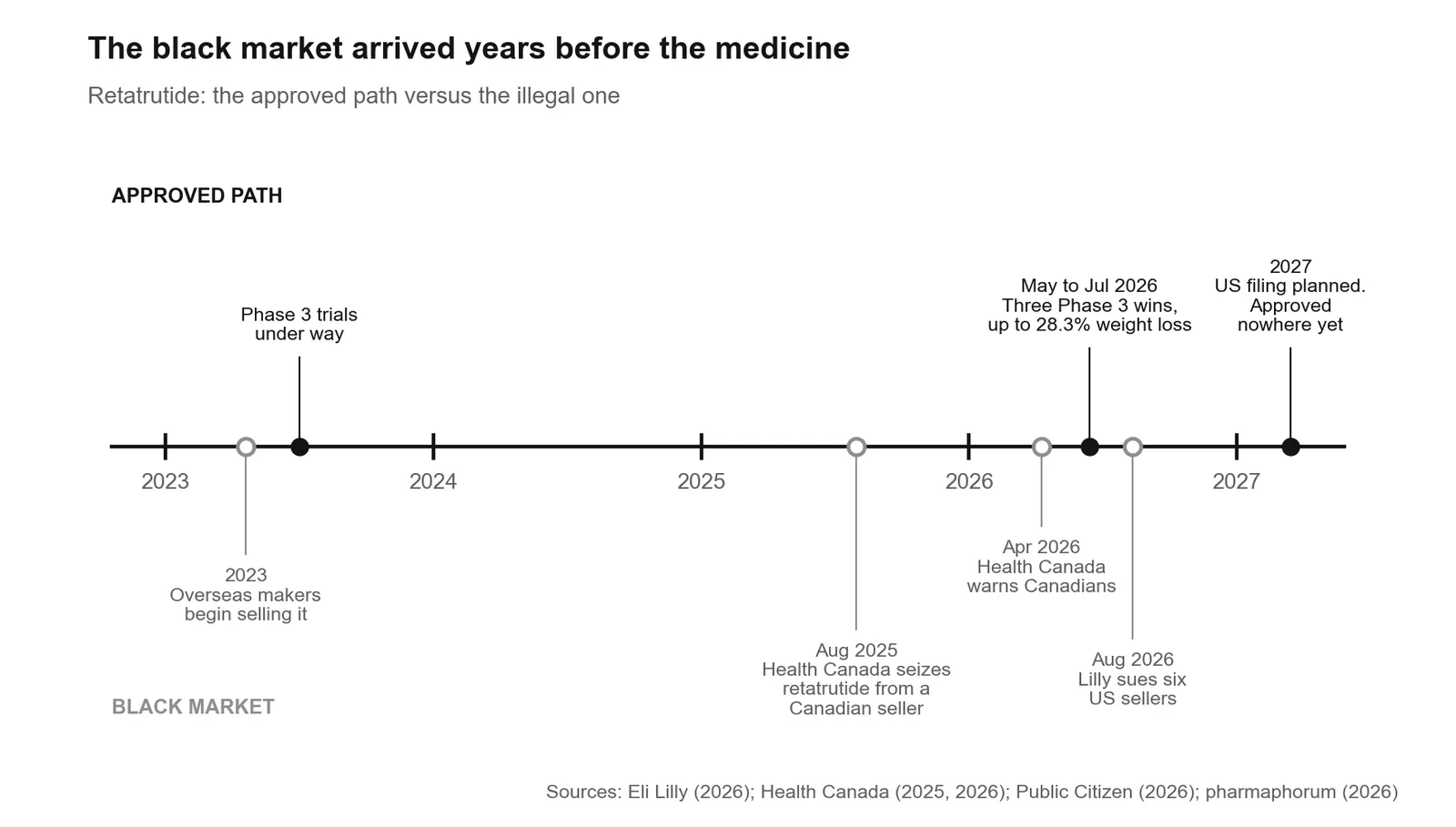
Retatrutide is the next step: a weekly injection from Eli Lilly that acts on three hormones at once, GLP-1, GIP and glucagon. In its first large Phase 3 trial, 2,339 adults took part over 80 weeks. On the highest dose, average weight loss was 28.3%, and 45.3% of participants lost at least 30% of their body weight (Eli Lilly, 2026a). Two more Phase 3 trials followed in July 2026, in people with type 2 diabetes and in people with severe obesity and heart disease. Both succeeded. Lilly plans to file for approval in the United States in early 2027 (Eli Lilly, 2026b).
Results like these used to require surgery. So the appetite is enormous. In Canada alone, measured adult obesity rose from 25% in 2016 to 2019 to 33% in 2022 to 2024 (Statistics Canada, 2025).
Put a medicine that works this well in front of a market that large, make people wait years, and a shadow industry will not wait with them.
The Market That Moved Faster Than the Medicine
Overseas manufacturers, many of them in China, began selling retatrutide as a "research peptide" as early as 2023, while its trials were still running. By 2026, more than 100 companies were selling it openly, and it had become the most searched unapproved peptide online. A testing service that reviewed 179 vendors rated 71 of them poor, bad or fraudulent. The US Food and Drug Administration had sent 14 warning letters since 2024; by May 2026, eight of those sellers were still selling (Public Citizen, 2026).
Canada is part of that map. In August 2025, Health Canada seized unauthorized injectable peptides, including retatrutide and tirzepatide, from a Canadian online seller (Health Canada, 2025). In January 2026 it warned that retailers in Canada, both in stores and online, were selling unauthorized GLP-1 products such as semaglutide and tirzepatide, and that some websites and ads misused Health Canada logos (Health Canada, 2026a). In April 2026 it warned Canadians to think twice before injecting peptides bought online, naming retatrutide, and noting that a "research use only" label does not make a product legal (Health Canada, 2026b).
In August 2026, Lilly sued six American sellers. Products it had seized ranged in dose from nothing at all to overdoses. Some contained insulin instead (pharmaphorum, 2026).
What Is Actually in the Vial
The danger is not only that these products are unapproved. It is that nobody knows what they are.
When researchers bought semaglutide from illegal online pharmacies, only three of six sellers delivered anything. The rest demanded extra payments of US$650 to US$1,200. Of the samples that arrived, purity was 7 to 14% against the 99% promised, the amount of drug ran 29 to 39% above the label, and one sample carried elevated levels of bacterial endotoxin (Ashraf et al., 2024).
Fake pens have filled with insulin. In Austria in 2023, several people were hospitalized with dangerously low blood sugar and seizures after using counterfeit Ozempic (PharmaLive, 2023). In 2024, the World Health Organization issued an alert on falsified semaglutide after fake batches surfaced inside the regulated supply chains of Brazil, the United Kingdom and the United States (World Health Organization, 2024). By May 2026, the FDA had received 990 adverse event reports for compounded semaglutide and more than 730 for compounded tirzepatide, figures it says are likely undercounts (US Food and Drug Administration, 2026).
A real medicine is defined less by its molecule than by everything around it: a licensed factory, tested batches, sterile filling, a label that tells the truth, and a regulator who checked. Take those away and what is left is a gamble.
The Numbers Are Climbing Everywhere
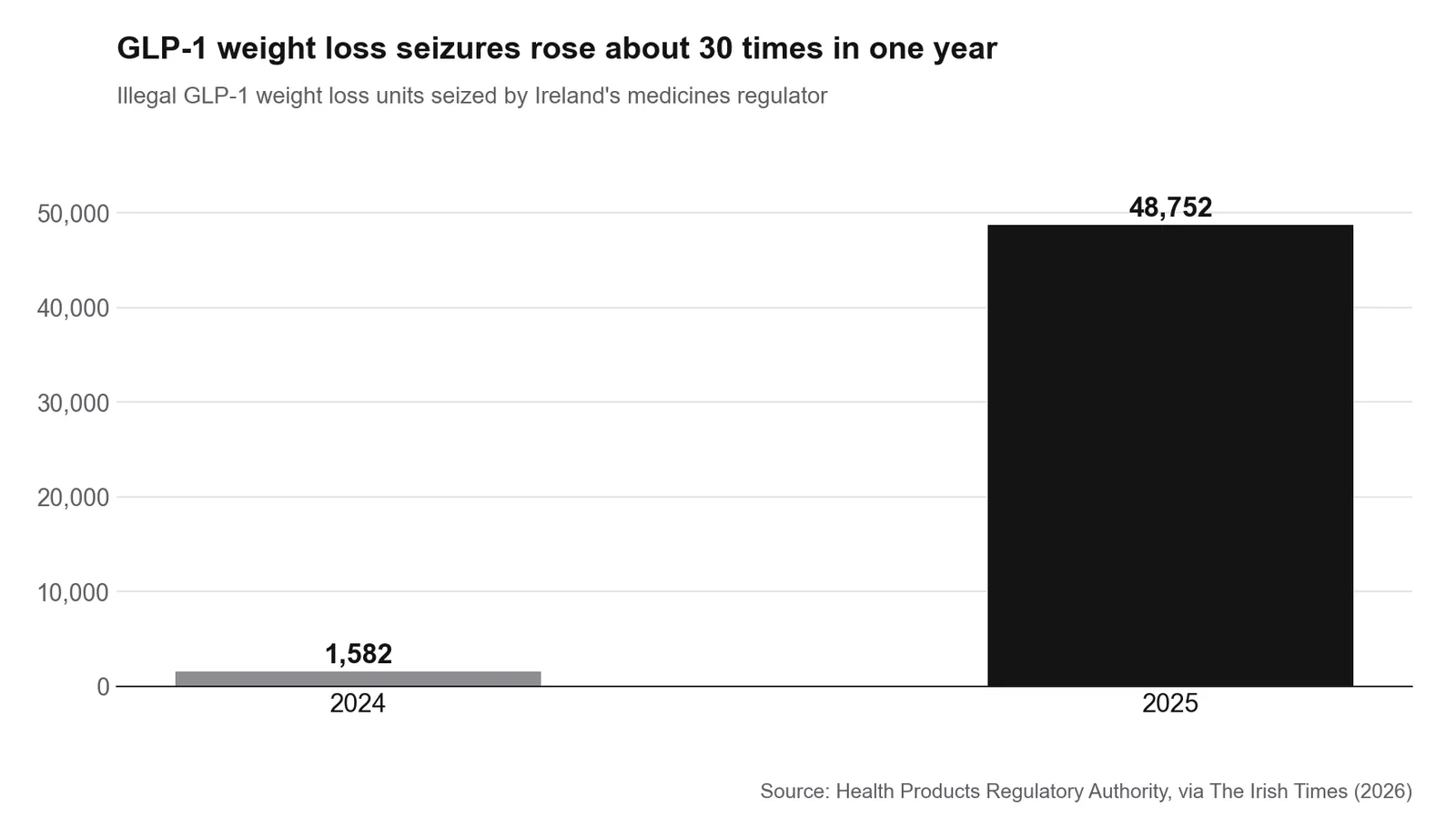
Ireland's medicines regulator seized 48,752 illegal GLP-1 weight loss units in 2025, up from 1,582 the year before, about 30 times more (Irish Times, 2026).
Globally, Interpol's Operation Pangea XVII ran in 90 countries from December 2024 to May 2025. It seized 50.4 million doses worth US$65 million, made 769 arrests, dismantled 123 criminal groups and shut down about 13,000 websites and social media pages. Weight loss drugs were seized in Asia Pacific, Europe and North America, and Canada was named among the countries with large seizures (Interpol, 2025). At Canada's border during the operation, Health Canada inspected 19,193 parcels, refused entry to 7,096 and seized 539 (Health Canada, 2025b).
The World Health Organization estimates that at least 1 in 10 medicines in low and middle income countries is substandard or falsified (World Health Organization, 2024b). Weight loss drugs are bringing that problem into wealthy countries' living rooms.
Price and Access Feed the Black Market
Counterfeiters do not create demand. They harvest the gap between what people want and what they can get.
In Canada, public drug plans do not cover Wegovy for obesity. In 2025, Novo Nordisk declined talks to add it to public plans, leaving a list price of about C$5,066 a year for people paying themselves (Global News, 2025). When a medicine is expensive, uncovered and in the news every week, a cheaper vial online looks tempting.
The opposite is also true. Once semaglutide was open to generic competition in Canada, Health Canada approved the first generic in April 2026, making Canada the first G7 country to do so (Health Canada, 2026c), with another following days later at about a third of Ozempic's price (CTV News, 2026). A fast, legitimate, affordable option is one of the strongest weapons against a fake one.
At the Canada Health Innovation Challenge in Toronto this October, the room heard the same conclusion from industry, patients and policy leaders alike: private companies cannot police this alone. Shutting down one website takes weeks. Opening a new one takes an afternoon.
Where the Ingredients Come From
Much of the illegal active ingredient comes from a small number of overseas producers. One US analysis found 239 shipments of semaglutide and tirzepatide from unregistered foreign makers, of which regulators stopped 44; 60 came from China or Hong Kong and 42 from India (Partnership for Safe Medicines, 2025). One retatrutide import declared 222,930 pieces in a single shipment (Partnership for Safe Medicines, 2026).
Compare that with the legitimate path. In Canada, anyone who makes, packages, tests, imports or distributes a drug needs an establishment licence and must show they follow Good Manufacturing Practice, and Health Canada inspects them to check (Health Canada, 2020). Those rules are the reason a pharmacy vial is safe. They are also exactly the steps a counterfeiter skips.
The Cost of Doing Nothing
It is tempting to treat counterfeits as a policing problem at the edge of health care. The bill lands in the middle of it.
- Health systems pay for the emergency visits, hospital stays and infections that follow a bad vial, with no way to track how many there are.
- Manufacturers and investors lose more than sales. Every fake that harms someone erodes trust in the real medicine. And if a breakthrough can be copied and sold before it is approved, the reward for investing a decade in developing it shrinks. That hits smaller companies hardest, including the biotech and medtech startups every country says it wants to grow.
- Regulators lose control of safety data on drugs that millions are already using, years before the official record begins.
- Patients carry the rest, often without knowing it.
What Would Shut the Market Down
No single fix will do it, but the pieces are known.
- Coordinated enforcement. Border services, police and health regulators sharing data and acting together, rather than one website at a time.
- Faster legitimate access. Every month a proven medicine is unavailable or unaffordable is a month the black market has no competition.
- Supply chain traceability. Serialized packaging and verified distribution make fakes harder to slip into real pharmacies.
- Clearer, faster paths to market for legitimate makers. Including generics, biosimilars and new devices, so quality products arrive sooner and at lower cost.
- Public education. Plain language on why "research use only" is a warning, not a loophole.
The last two are where better regulatory infrastructure matters most. Counterfeiters thrive in the time it takes to do things properly. Shrink that time without cutting corners and their window closes.
PERSPECTIVE
Speed Is a Safety Feature
By Nye Dafalla, Chief Executive Officer, Fjord IQ
I spend my days helping medical technology teams through regulatory approval, so it is strange to write about a market that skips approval entirely. But the black market for weight loss drugs taught me something about our own industry.
Counterfeiters are fast because they skip every step that makes a product trustworthy: the quality system, the testing, the documented manufacturing, the review. Legitimate companies are slow partly because those steps are hard, and partly because the way we manage them is still scattered across spreadsheets, consultants and guesswork. The first kind of slowness protects patients. The second kind protects no one, and it hands the counterfeiters their head start.
That second kind is the one we can fix. At Fjord IQ, we build regulatory intelligence software that shows a medical device team, from the first day of design, what its device class is, which standards apply, what evidence a regulator will expect and how its quality system needs to be built. It does not remove a single safety step. It removes the months lost finding out what those steps are.
Multiply that across thousands of companies and you get more safe products, from more makers, reaching people sooner. That is what pushes a black market out.
So here is my ask to everyone with a stake in this:
- Investors: treat regulatory and quality infrastructure as part of the product, not overhead. It is what makes a company's revenue defensible.
- Health systems and payers: count the hidden costs of fakes when weighing the price of the real thing.
- Regulators and enforcement agencies: share data across borders as fast as counterfeiters share websites.
- Builders: make quality and compliance a design input from day one.
The safest market is one where the legitimate product gets there first.
Frequently Asked Questions
What is semaglutide? A medicine that mimics GLP-1, a gut hormone that boosts insulin, slows digestion and reduces appetite. It is sold as Ozempic for type 2 diabetes and Wegovy for weight management. Tirzepatide (Mounjaro, Zepbound) and retatrutide are related drugs that act on more than one hormone.
Is retatrutide approved in Canada or the United States? No. As of October 2026, retatrutide is not approved anywhere. Eli Lilly plans to file for US approval in early 2027.
Is it legal to buy "research use only" peptides in Canada? Health Canada says these products are unauthorized, has seized them from Canadian sellers and warns that the label does not make them legal or exempt from the rules.
How can I tell if a GLP-1 medicine is counterfeit? Buy only from a licensed pharmacy with a prescription. Health Canada says only licensed pharmacies can legally sell prescription drugs in Canada, and warns that some websites and ads misuse its logo.
Why are counterfeit weight loss drugs rising? High demand, high prices, limited public coverage and products that can be sold online all create an opening for counterfeiters.
What is Good Manufacturing Practice? A set of rules for how drugs are made, tested, stored and documented. In Canada, drug establishments must meet them to hold a licence, and Health Canada inspects them.
Sources
- Ashraf, A. R., Mackey, T. K., et al. (2024, August 2). Safety and risk assessment of no prescription online semaglutide purchases. JAMA Network Open. Also reported by NBC News: Nearly half of online pharmacies selling weight loss drugs are operating illegally, study finds.
- CTV News (The Canadian Press). (2026, May 20). At a fraction of the cost of Ozempic, generic semaglutide to hit Canadian pharmacies this week.
- Eli Lilly and Company. (2026a, May 21). Lilly's triple agonist, retatrutide, delivered powerful weight loss in pivotal Phase 3 obesity trial.
- Eli Lilly and Company. (2026b, July 23). Lilly's triple agonist, retatrutide, successful in two additional Phase 3 obesity trials, delivering significant improvements in weight and A1C. BioSpace.
- Global News. (2025, December 3). Wegovy won't be in Canadian public drug plans as Novo Nordisk refuses talks.
- Health Canada. (2020). Good manufacturing practices guide for drug products (GUI-0001): Summary.
- Health Canada. (2025, August 1). Unauthorized injectable peptide drugs seized and sold by Canada Peptide may pose serious health risks.
- Health Canada. (2025b, June 25). Buying health products online? Know the risks.
- Health Canada. (2026a, January 21). Thinking about buying GLP-1 drugs like Ozempic or Mounjaro? Beware of fake or unauthorized products.
- Health Canada. (2026b, April 9). Think twice before injecting peptides bought online: unauthorized products can seriously harm you.
- Health Canada. (2026c, April 28). Canada becomes the first G7 country to approve a generic version of semaglutide.
- Interpol. (2025, June 25). Record 769 arrests and USD 65 million in illicit pharmaceuticals seized in global bust.
- Irish Times. (2026, March 24). Huge increase in number of fake and illegal weight loss drugs seized by medicines watchdog.
- Partnership for Safe Medicines. (2025, February 20). New report reveals illegal ingredients for knockoff weight loss drugs flooding into U.S. from foreign sources, endangering patient safety.
- Partnership for Safe Medicines. (2026, August). Tens of thousands of units of retatrutide: May and June 2026 freight fraud report.
- pharmaphorum. (2026, August 12). Lilly sues over "illegal sales" of obesity drug retatrutide.
- PharmaLive (Reuters). (2023, October 24). Suspected fake Ozempic puts several in hospital in Austria.
- Public Citizen. (2026, June 16). The "miracle drug" and the peptide craze breaking the FDA.
- Statistics Canada. (2025, October 2). The prevalence of overweight and obesity is on the rise in Canada: New results from the Canadian Health Measures Survey, 2022 to 2024. The Daily.
- US Food and Drug Administration. (2026, updated October 1). FDA's concerns with unapproved GLP-1 drugs used for weight loss.
- World Health Organization. (2024, June 19). Medical Product Alert N°2/2024: Falsified OZEMPIC (semaglutide).
- World Health Organization. (2024b, December 3). Substandard and falsified medical products.
About This Article
Fjord IQ is an AI native regulatory intelligence platform that helps medical technology and life sciences teams navigate FDA and Health Canada approval. Fjord IQ attended the Canada Health Innovation Challenge in Toronto on October 23, 2026. Figures in this article come from the published sources listed above. Fjord IQ has no financial relationship with any company named.