

It took seven years for Keith Loo's family to learn the name of the condition their son Logan was born with.
Logan was born in York Region with an ultra rare genetic disorder (Audacity North, 2026; Destination Toronto, 2025). For most of his childhood, there was no diagnosis to look up, no research to follow and no community of other families to call. Conditions this rare often go unnamed for years, simply because so few people have them.
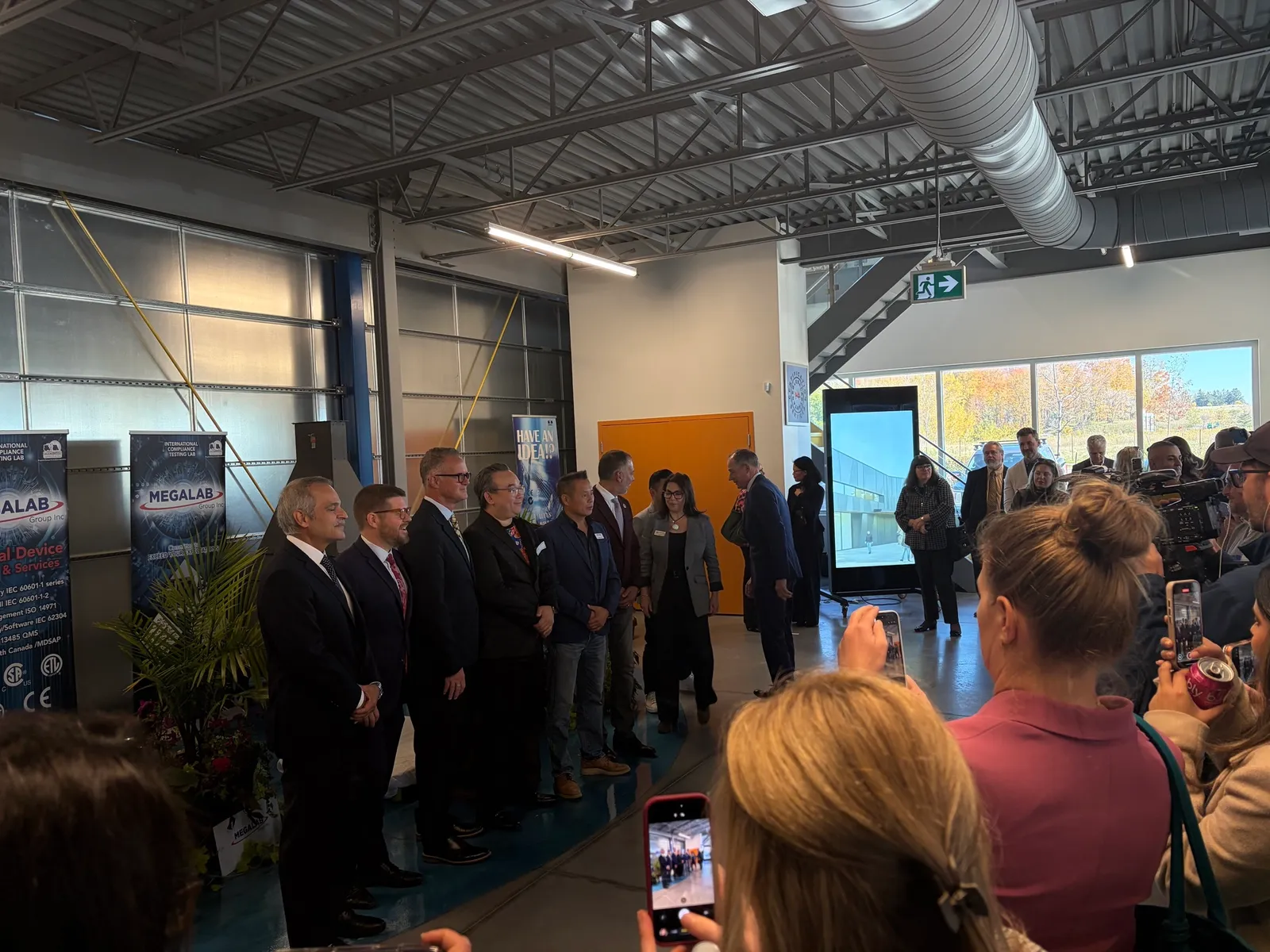
On Monday, Logan's father stood inside a testing laboratory in Aurora, Ont., and announced what its partners say will become Canada's largest MedTech and life sciences hub. Its plans include a research institute named after his son.
What Audacity North Is
The hub is called Audacity North. It is a federal not for profit organization started by Keith Loo, CEO of the skin health company Skinopathy, which he started from his home in Aurora, and Garry Lee, who built Megalab, the accredited test lab where the announcement took place.
The founding partners are Megalab, the Schulich School of Business and YSpace, York University's innovation and entrepreneurship hub. It was launched with the Town of Aurora and the Town of Whitchurch-Stouffville, with the support of both mayors.
Programs begin at Megalab next year. Construction on an 86 acre campus in Whitchurch-Stouffville is planned for late 2027, with the first building scheduled to open in 2028.
Among the plans still in development is the Logan Institute for Rare Disease Research, a charitable research institute named for Logan. It aims to fund rare disease research, provide lab space, and build a patient registry and a biobank, so the next family does not have to wait seven years for an answer.
The Same Problem, from Every Side of the Room
Loo and Lee were joined by Amir Asif, York University's Vice President, Research and Innovation; Jennifer Klotz-Ritter, President and CEO of the Southlake Health Foundation; and Chris Carder, Executive Director of Schulich's Office of Innovation and Entrepreneurship and the inaugural Jay Smith and Laura Rapp Chair in Innovation and Entrepreneurship.
I went expecting a launch event. What surprised me was how quickly the conversation turned into agreement.
A university research leader, a business school, a hospital foundation, a test lab and a company CEO all described the same thing. Canada is excellent at research and discovery. Where we stall is commercialization, and getting Canadian innovation represented on the global stage.
The numbers back that up. Of 3,164 licence and IP agreements made by ten leading Canadian research universities over five years, 69% went to partners outside the country (AUTM Canadian Public Policy Advisory Committee, n.d.). Canadian life sciences startups raise 75 to 85% less capital than their American peers (McIntyre, 2026).
In other words, we invent it here and someone else brings it to the world.
Why the Hospital Matters
For me, hearing from Jennifer Klotz-Ritter was one of the most important parts of the day.
A medical device can pass every test and still never help anyone if no hospital is willing to adopt it. Hospitals are where new technology either becomes care or quietly disappears.
Under her leadership, the Southlake Health Foundation has helped bring new technology into a community hospital. In June 2026, Southlake became the first hospital in York Region to offer robotic assisted surgery with the da Vinci Surgical System, made possible by community donors, with cardiac surgery planned next (Southlake Health, 2026).
That is stewardship in a very practical sense. A community decides together that its hospital should have what is new, and someone does the hard work of making it happen. Audacity North says it is in discussions with hospitals. Having a hospital foundation leader speak at its launch shows how much that relationship will matter, because a device is not finished until a hospital is ready to use it.
Inside Megalab: Medical Device Testing in Ontario
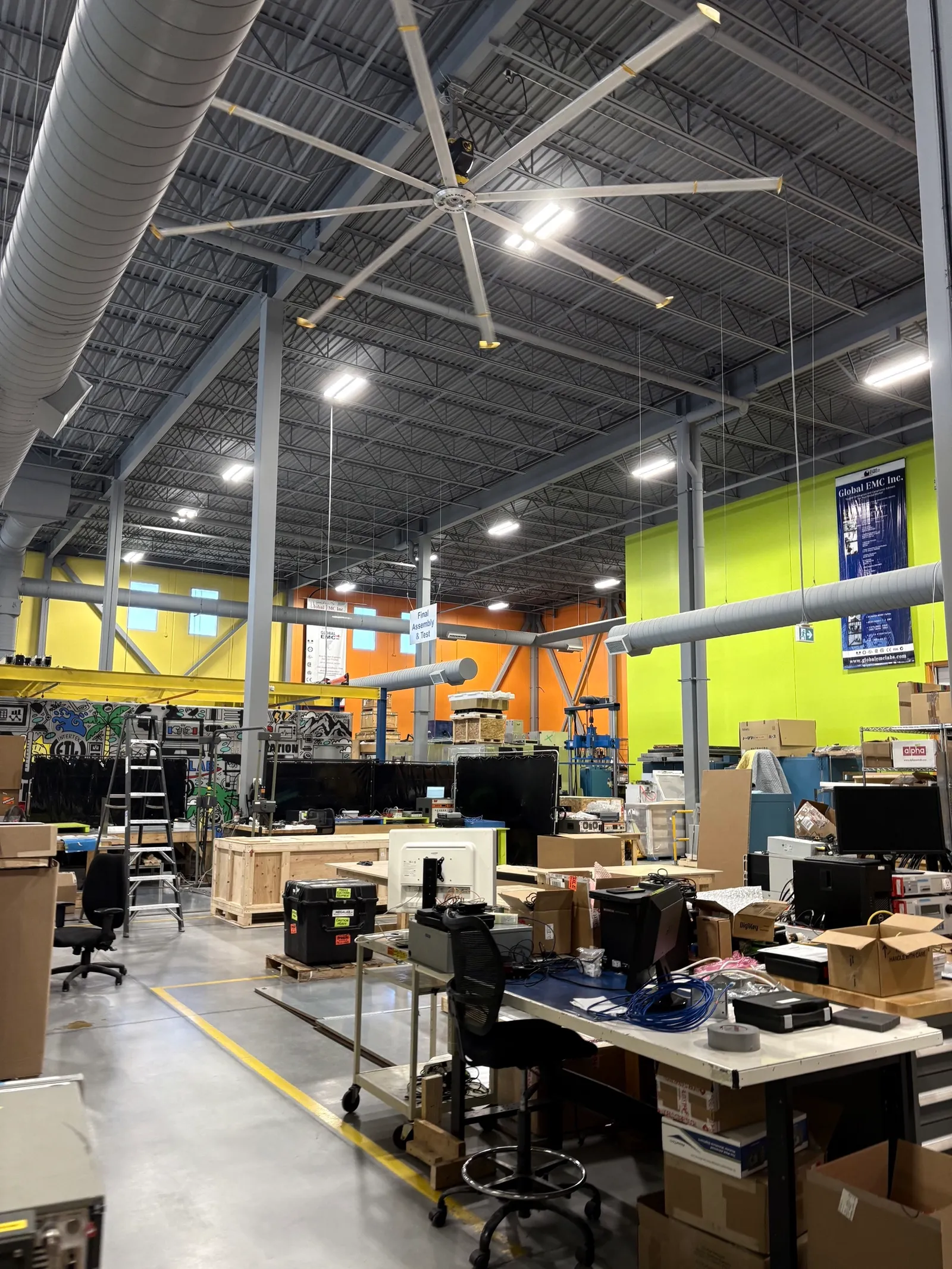
After the speeches, Doug McIntyre, a partner who joined Megalab in its early days, took visitors through the lab.
Megalab, billed by its partners as Canada's largest and newest full certification test lab, began in about 1,400 square feet checking whether products were electrically safe. Today a device can arrive as a prototype and leave with the evidence it needs to be sold, without changing buildings. The lab is accredited to ISO/IEC 17025 and can file results with Health Canada or the U.S. Federal Communications Commission on a client's behalf.
The easiest way to understand the place is to follow a device through it. Picture a portable patient monitor that will one day ride in ambulances.
The Chamber
Before you go in, you leave your phone on a table outside.
The main chamber is 10 metres long and lined with steel, so no signal from the outside world can get in. Inside, antennas surround the monitor and fire radio frequencies at it, then listen to what it gives off in return. The question is simple and unforgiving. Will this monitor keep working next to a defibrillator, a paramedic's radio and a dozen phones, and will it stay quiet enough not to disturb them?
In a smaller 3 metre chamber, the team can sit in front of screens and watch their device perform in real time, making small adjustments as they go. A separate fireproof chamber lets them push a device with chosen frequencies to see where it breaks.
The Real World, on Demand
Next door, the environmental lab recreates everything the road can throw at the monitor.
A shake table bolts the device down and moves it in every direction at once, imitating years of potholes and slammed ambulance doors. Water baths, high pressure spray and salt spray test what rain, a spill or a winter road will do to it. Hot and cold chambers carry it from desert heat to Arctic cold and back again, and check whether the condensation that forms when it comes inside, the same fog you get on your glasses, shorts anything out.
There is even an earthquake table, sitting on six feet of reinforced concrete, for equipment that has to keep standing when the ground does not.
Safe to Plug In
The product safety lab asks whether the monitor is safe to touch, plug in and rely on, often to the IEC 60601 family of standards written for medical electrical equipment.
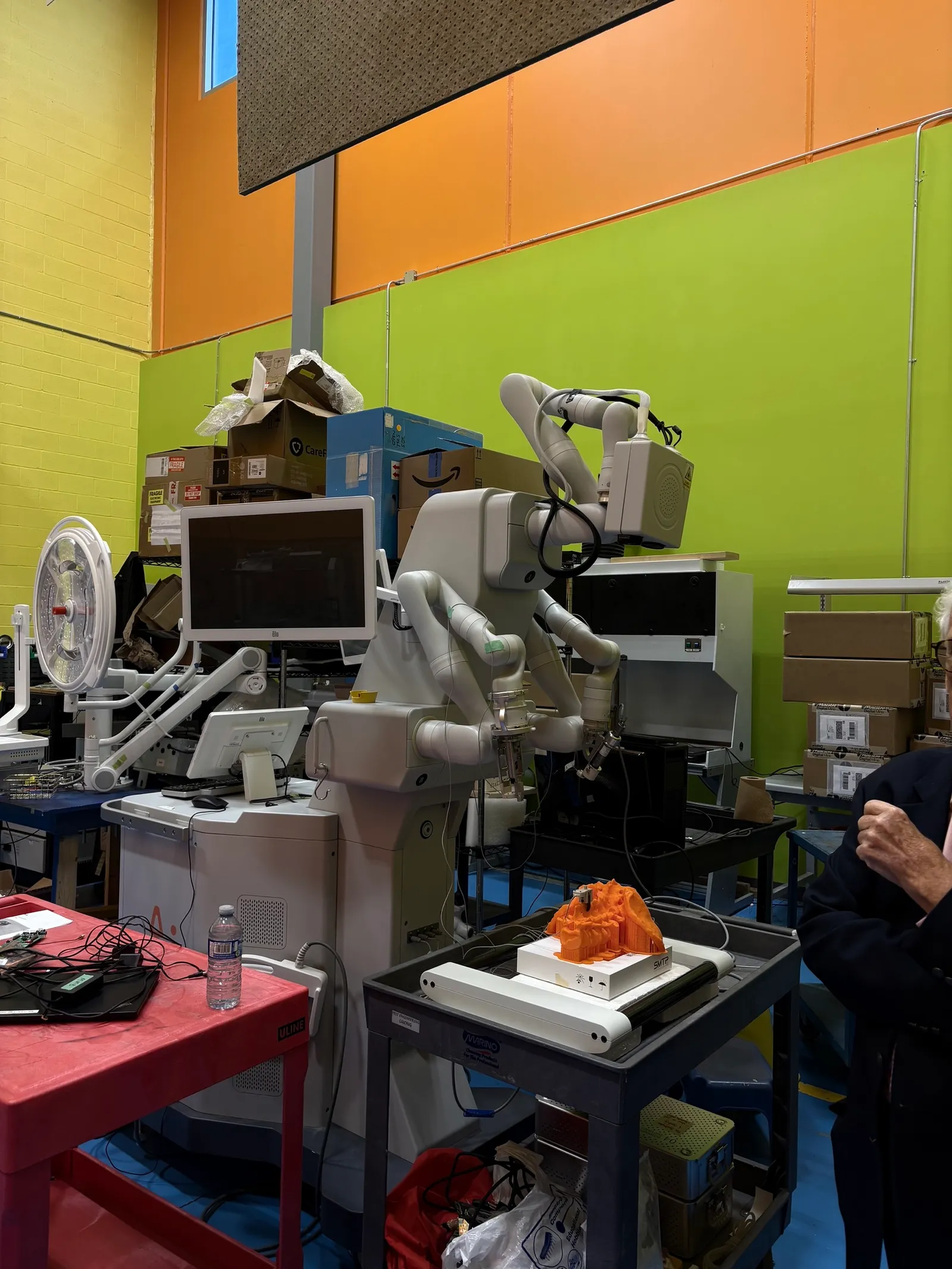
On the day of the tour, it held an optical diagnostic tool for opticians, a spinal support system developed with a London, Ont., hospital and a low energy surgical light, with a surgical robot standing nearby. Over the years this room has seen MRI systems, ultrasound, CPAP machines and systems that keep donor organs alive in transit.
Ready to Ship
Finally, the packaging lab stacks, crushes and shakes boxed product the way a truck or cargo plane would. Megalab is certified to test to Amazon's packaging standards, so a device that survives here should arrive in one piece.
Where It Is Different
What sets Megalab apart is less the equipment than how it is used.
Teams are welcome to sit beside the engineers through every test. If an early look shows a plastic case will never pass, they hear it before they book a full test. If something fails, a soldering bench the staff call the "battle station" lets an engineer move a component and run the test again the same afternoon. Teams that cannot travel watch fixes sketched on a whiteboard that appears on their own screens. The lab aims to finish projects in weeks rather than months.
The support reaches past the test itself. One engineer sits on a standards committee, so the lab sees new rules before they arrive, including emerging expectations for the security of AI systems. A cybersecurity consultant now advises clients on connected devices, and a specialist with medical industry experience helps young companies build quality systems for manufacturing.
McIntyre helped start the incubator that became ventureLAB and advised Communitech in Waterloo as it built its programs.
What Has Come Through
One device that passed through Megalab was an early compact MRI from Toronto's Synaptive Medical. It became Evry, a head MRI approved by Health Canada in 2020 that can be installed without the reinforced floors a full size scanner needs (Synaptive Medical, 2020). Halifax's QEII Health Sciences Centre put one beside its emergency department (Canadian Healthcare Technology, 2020).
The lab is now testing an ultrasound based breast cancer screening tool designed to spare patients a more uncomfortable exam.
That is the path Audacity North wants to make ordinary: a Canadian idea, tested in Canada, used in a Canadian hospital, and then sold to the world.
What This Means for Canada's Economy
Medical devices are already a major Canadian industry, and most of it is in Ontario. In 2023 the sector contributed C$13.7 billion to the economy and supported 88,394 full time equivalent jobs. Ontario accounted for 61.1% of that contribution and 57.6% of the jobs (Statistics Canada, 2025).
Every device that is invented here and also tested, built and sold here keeps more of that value at home. The hub's bet is that putting research, testing, hospitals and capital in one region will make that happen more often.
PERSPECTIVE
What It Really Takes to Build a Medical Device
By Nye Dafalla, Chief Executive Officer, Fjord IQ
I build regulatory software for medical device teams, so I spend a lot of time thinking about the gap that everyone in that room described.
The research is not the problem. The problem is that the steps after discovery, like testing, regulatory approval, hospital adoption and investment, often arrive late and one at a time. A team finishes a design, then learns it needs a metal enclosure. It finishes testing, then learns what the regulator expects. Each discovery means going back.
Logan's story is a reminder of who is waiting at the end of that process. Seven years is a long time to wait for a name. Medical devices can take years to reach patients too, and much of that time is lost when the next step is only found once the last one is done.
If you are building a device, ask these questions before your first prototype is finished:
- Which standards apply to my device? For most electrical medical devices, that starts with the IEC 60601 family for safety and electromagnetic compatibility.
- Will my design pass as it is? A short conversation with a test engineer at the prototype stage can save months of redesign.
- Where will my device be used? An ambulance and an operating room ask very different things of a device.
- What will the regulator ask for? Knowing your device's class and pathway early shapes every decision after it.
- Which hospital will use it first? Adoption is part of the plan, not something that happens after it.
A hub like Audacity North puts the people with these answers in one place. Tools like ours put the regulatory answers in front of a team on the first day of design. Neither replaces the other, and Canada needs both.
What I took away from Monday is that the people who can fix this are already talking to each other. The rest of us should join them, and build here.
Sources
- Audacity North. (2026). Audacity North. Retrieved October 19, 2026.
- AUTM Canadian Public Policy Advisory Committee. (n.d.). Where do Canadian research innovations go? AUTM. Retrieved October 14, 2026.
- Canadian Healthcare Technology. (2020, March 4). Health Canada approves new point of care MRI.
- Destination Toronto. (2025, February 26). An insider's Toronto: MedTech maverick Keith Loo.
- Maloney, G., Huda, M., & Abou Eid, N. (2025, December 22). The Canadian medical devices manufacturing sector, 2023. Statistics Canada.
- McIntyre, C. (2026, February 23). Canada's sluggish startup growth has cost its tech scene more than US$66B. The Logic.
- Megalab Group Inc. (n.d.). Megalab. Retrieved October 19, 2026.
- Southlake Health. (2026, June 19). Southlake Health first in York Region to offer Da Vinci robotic assisted surgery.
- Synaptive Medical. (2020, February 20). Synaptive Medical secures Health Canada approval for Evry. BioSpace.
About This Article
Fjord IQ is an AI native regulatory intelligence platform that helps medical technology and life sciences teams navigate FDA and Health Canada approval. Fjord IQ attended the Audacity North announcement and toured Megalab. Details of Logan's story and the lab come from remarks and the tour at the event, and plans for the hub from Audacity North's published materials. Fjord IQ has no financial relationship with Audacity North or Megalab.